GRC lead
Follow the Submission Back to Its Request.
Maya’s view connects the approved record to its attachment, related request and Sam’s submission. That context lets the next reviewer inspect the basis for the decision.

Connect each request to its submission, independent review and permitted reuse.
Maya needs proof for the payroll access review. A filename alone leaves Sam guessing about scope and Maya guessing about relevance. A clear request, acceptance criteria and named provider give both a practical starting point.
Start from the relevant project control and its accountable owner.
Start from the relevant project control and its accountable owner. Name eligible evidence providers, set a due date and explain the required material, submission guidance and acceptance criteria. The request gives the provider a defined task.
Sam responds to the request with the material and a description of what it supports.
Sam responds to the request with the material and a description of what it supports. The submission retains its provider, request and control relationship. Uploading a file makes it available for review; it does not approve it.
A reviewer other than the uploader examines the submitted version.
A reviewer other than the uploader examines the submitted version. Approve it or request changes, retaining remarks and relevant validity dates. The recorded decision explains the review outcome for this evidence; it does not certify every requirement across the organisation.
When changes are requested, the provider addresses the feedback and submits a replacement version.
When changes are requested, the provider addresses the feedback and submits a replacement version. Earlier notes and history remain available. The reviewer considers the new submission. Approved evidence remains read-only; the generic resubmission flow is for returned evidence.
In the Integrated Control Matrix, select the source evidence, target control, scope and completed assessment period.
In the Integrated Control Matrix, select the source evidence, target control, scope and completed assessment period. Current mappings and applicability are prerequisites. Reuse needs its own independent approval; a mapping approval alone does not authorise it.
Assemble the permitted evidence and source references.
Assemble the permitted evidence and source references. Check current versions and approval before sealing. Grant the auditor appropriate project access and duration. Inspection, sealing and export remain distinct from an audit conclusion.
Choose a record. See what it means, who is responsible and what still needs to happen.
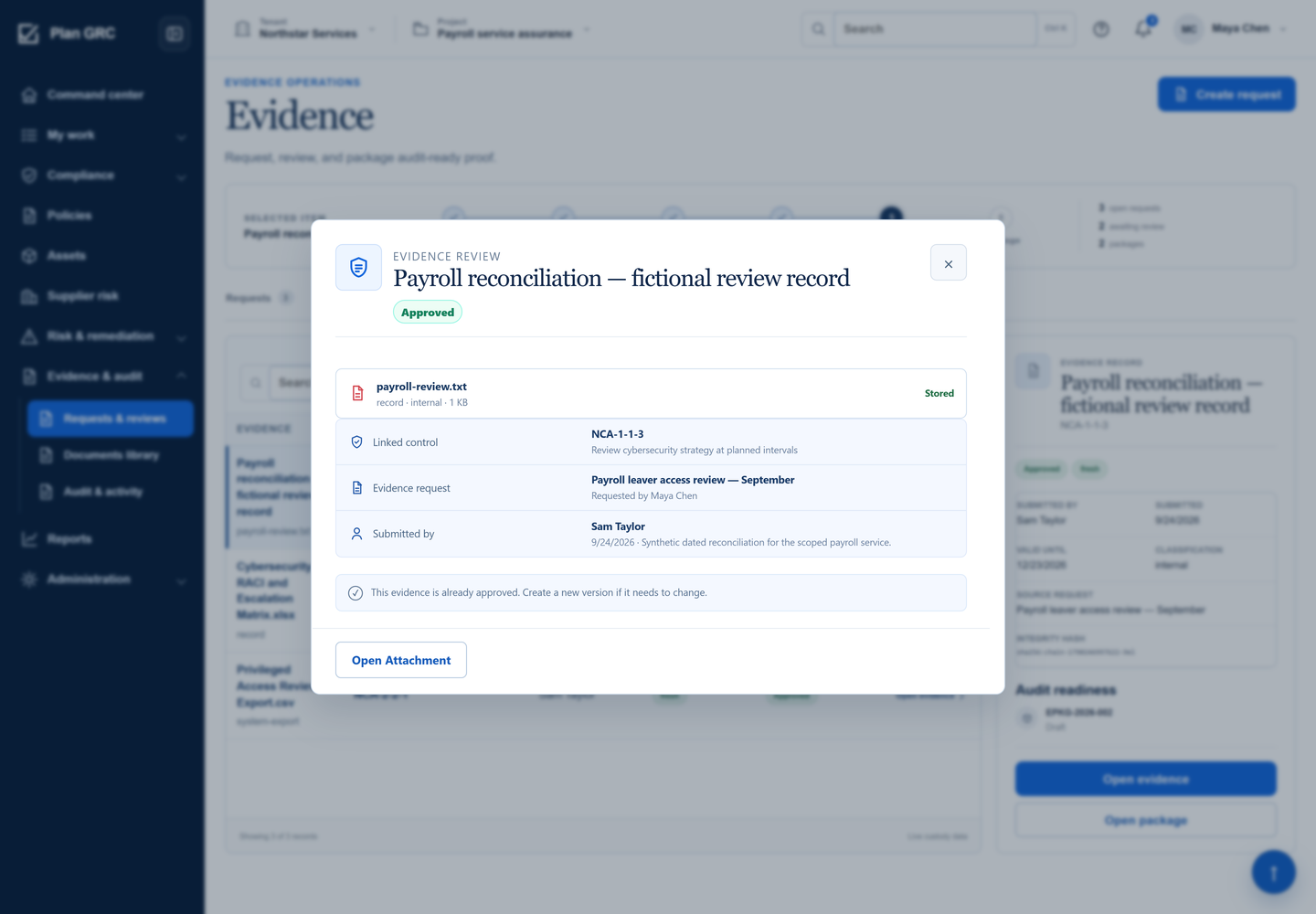
Maya’s view connects the approved record to its attachment, related request and Sam’s submission. That context lets the next reviewer inspect the basis for the decision.
Maya’s view connects the approved record to its attachment, related request and Sam’s submission. That context lets the next reviewer inspect the basis for the decision.
Approved review record, with its submitted source and request context. This is fictional product data.
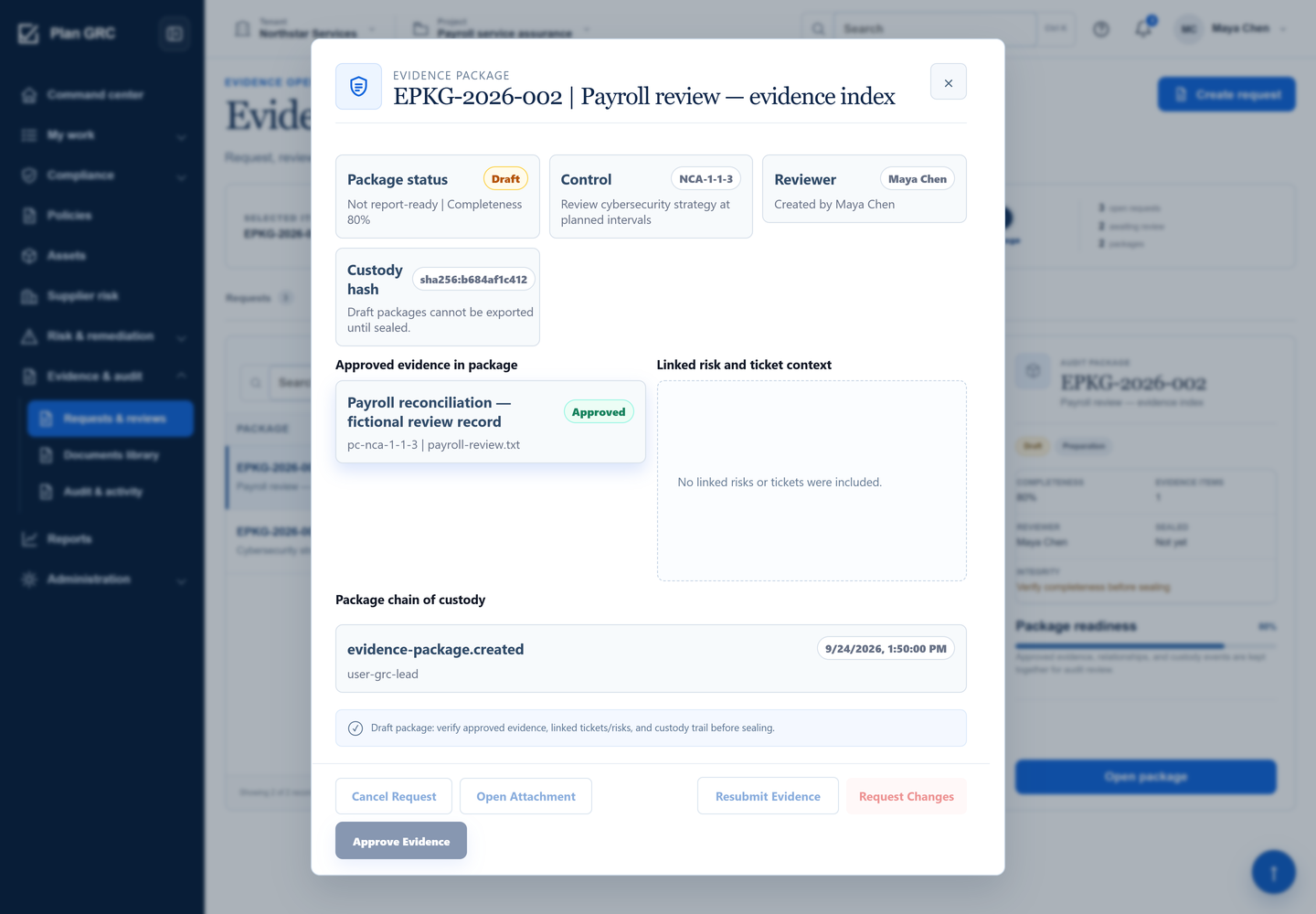
Open the original product screenThe payroll index contains one evidence item at 80% preparation. It remains unsealed and not report-ready. Inspect its contents and preparation checks before treating it as exportable.
EPKG-2026-002 remains an unsealed draft. Its preparation percentage is not an audit score.
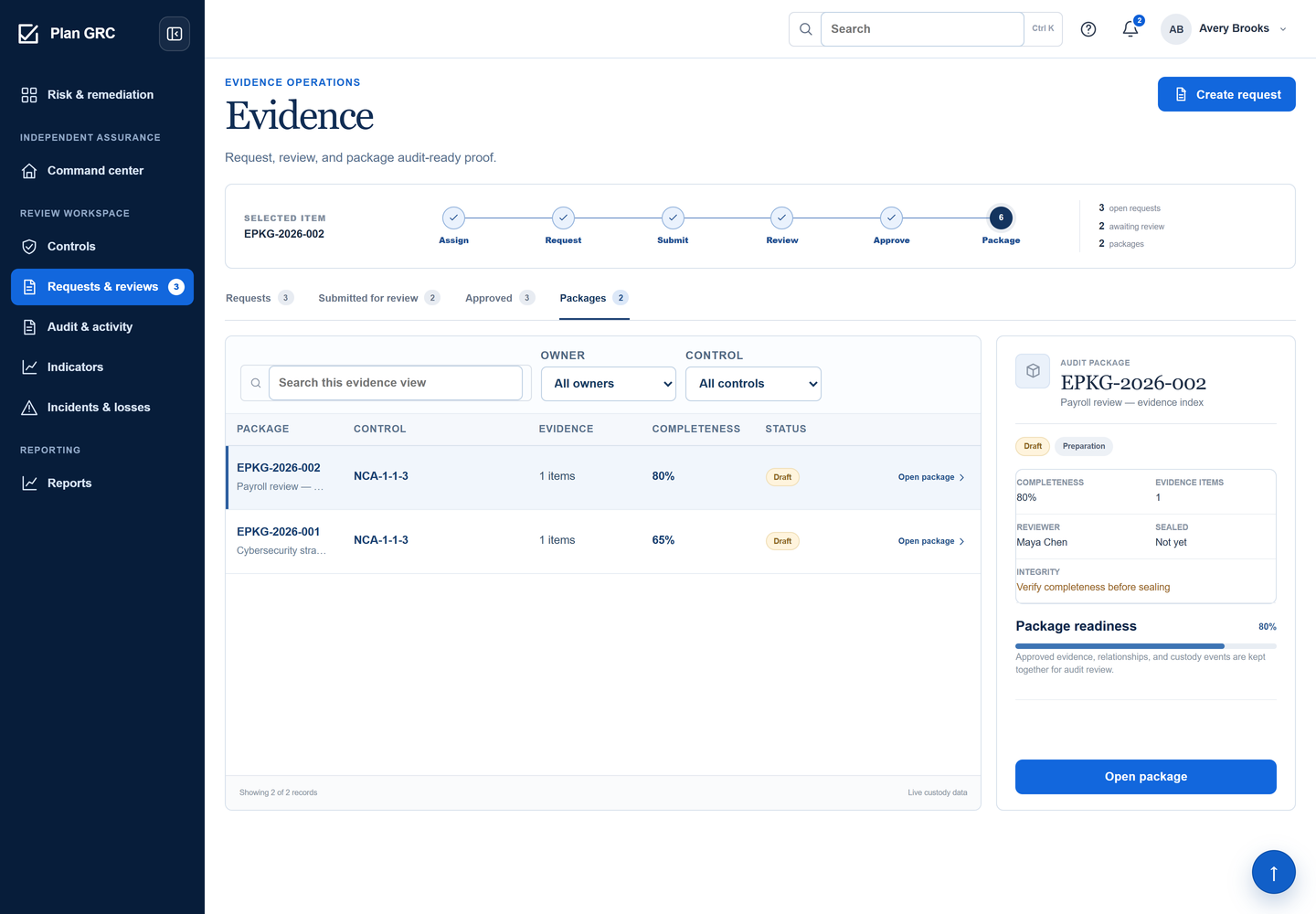
Open the original product screenAvery’s project grant permits inspection of the draft payroll index. Read-only access has a defined scope and duration; it does not grant evidence approval authority.
The auditor’s view of the same draft index, not a completed audit or unrestricted tenant access.
Open the original product screenMaya asks for evidence. Sam provides it. An independent review comes before the separate Customer Assurance reuse decision.
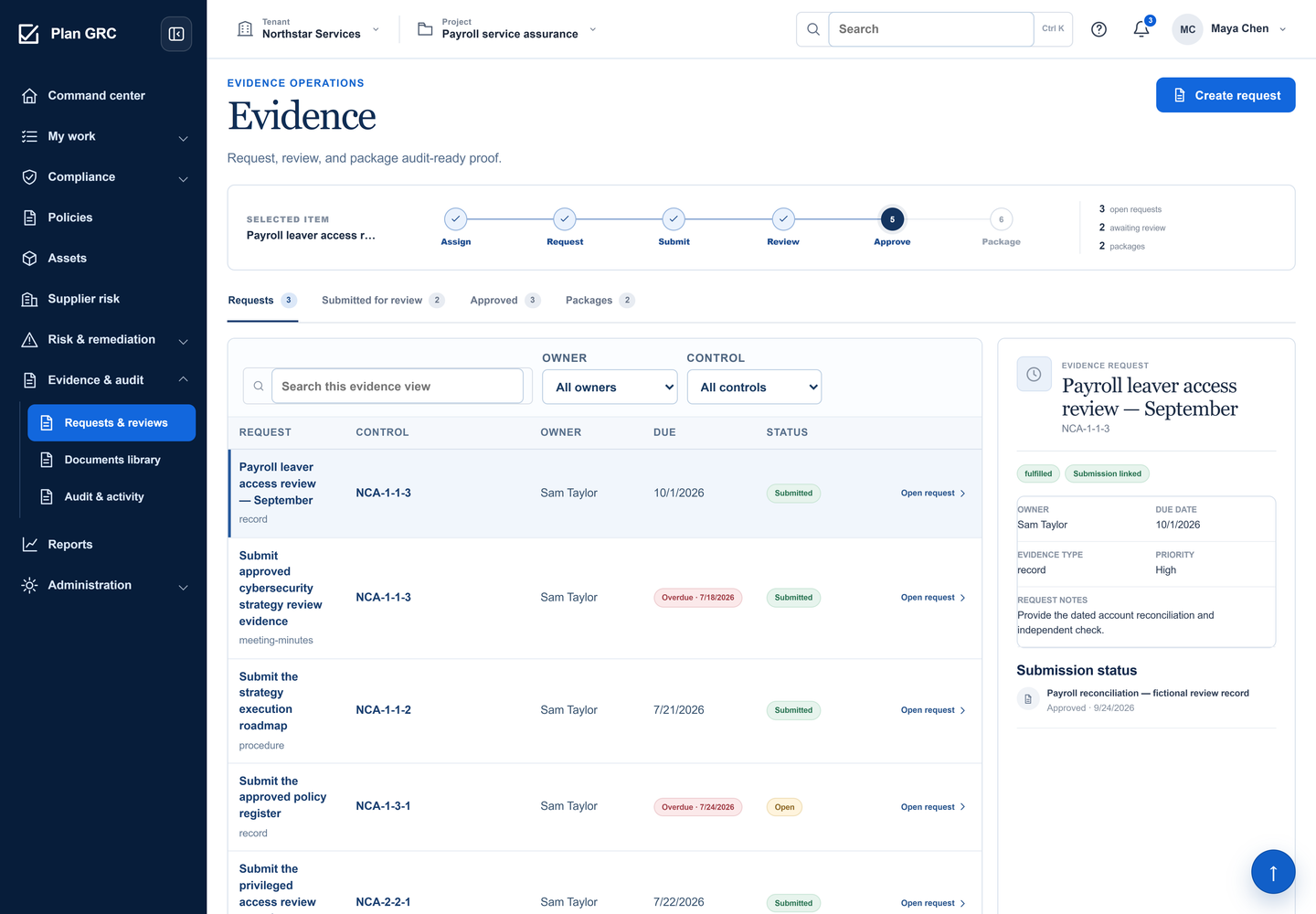
Maya asks Sam for the September payroll access review. The request names the owner, due date and expected record, including the dated reconciliation and independent check. Its submitted document stays connected to the request.
The owner knows what to provide, and the reviewer has a clear basis for checking whether it answers the request.
The captured request already has a submitted, approved document.
Fictional workspace · English interface
Maya asks Sam for the September payroll access review. The request names the owner, due date and expected record, including the dated reconciliation and independent check. Its submitted document stays connected to the request.
The owner knows what to provide, and the reviewer has a clear basis for checking whether it answers the request.
The captured request already has a submitted, approved document.
Open full product screen ↗Sam works from his assigned evidence requests. He can provide a file or an eligible library record, add context and respond to reviewer feedback. After submitting the payroll proof, this view shows his remaining tasks.
The owner spends less time searching for requests and more time supplying what the reviewer needs.
The owner submits evidence; an authorised independent reviewer approves it.
Open full product screen ↗Maya reviews the payroll reconciliation submitted by Sam. The approved record retains the request, submitter and source file. If the document needs to change, a new version preserves the earlier review context.
The next person can inspect what was reviewed instead of treating an attachment or filename as approval.
Sam submitted this version; Maya approved it.
Open full product screen ↗Maya references the approved payroll record in an assurance answer. Alex reviews that answer separately. The library keeps the supporting evidence, service limitation and expiry together for the next customer request.
The team can reuse suitable reviewed material while checking whether it fits the next request and recipient.
Library approval does not send an answer or approve every future disclosure.
Open full product screen ↗
The same source can support different work, but each destination has a separate decision to make.
Evidence validity, source requirements, mappings and delivery context matter to reuse. If the approved basis changes or the evidence expires, the earlier reuse decision may no longer be current and needs reassessment.
Use currently approved answers with their limitations. Evidenced answers need current approved support. Customer responses need separate review and disclosure confirmation. Export does not automatically email the customer.
The Documents Library manages source documents. An evidence submission carries its request, control context and evidence review. Where a document is used as a source, keep the recorded version and its relationship explicit.
Business approval records a reviewer’s decision. It is not a universal guarantee of a clean scan or verified file integrity. Check the source’s safety, integrity and access status as well as the requirements of the particular reuse or sharing workflow.
No. An authorised reviewer other than the uploader must approve the submission or request changes.
No. Providers work within their assigned scope. Auditors have read-only granted access. The standard executive role does not include evidence-reading permission; an overview is not access to the underlying files.
No. Sealing requires current approved evidence and the package preparation checks. Readiness supports review; it does not supply an auditor’s opinion or a certification. The illustrated package is still a draft.
A package must be sealed and report-ready before export. The output is a JSON or CSV manifest describing evidence and its references, not a ZIP containing every original file.
Follow the request, independent review and permitted inspection of its evidence.